
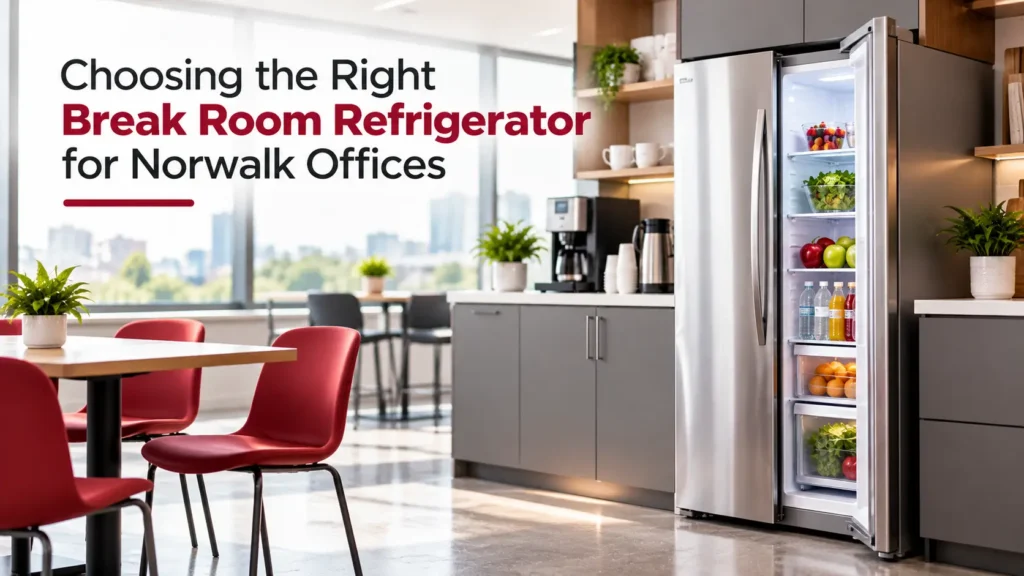
A refrigerator is one of the most frequently used appliances in a workplace break room, yet it is often selected with little consideration for how employees actually use it. A small refrigerator may seem sufficient during installation, but crowded shelves, limited storage, and missing lunch containers can quickly become everyday frustrations as the team grows.
For Norwalk businesses, choosing the right office refrigerator involves more than comparing appliance dimensions and prices. The best option depends on employee count, lunch habits, available space, food storage requirements, energy consumption, and whether the refrigerator will hold personal meals, company-provided refreshments, or both.
A well-planned refrigerator setup can make lunch breaks easier, improve organization, and support a more useful workplace refreshment area. This guide explains what Norwalk office managers should evaluate before purchasing a refrigerator, how to maintain safe shared food storage, and when a dedicated refreshment cooler may be a better option.
Why the Right Office Refrigerator Matters
A break room refrigerator serves several purposes throughout the workday. Employees use it to store packed lunches, yogurt, salads, beverages, and leftovers, while businesses may need additional space for milk, coffee creamers, meeting refreshments, and company-provided snacks. When these different needs compete for limited storage, even a relatively new appliance can become inconvenient.
A suitable refrigerator helps employees keep food organized and accessible while reducing unnecessary crowding. It also gives office managers a clearer way to separate personal food from shared supplies, establish cleaning responsibilities, and monitor refrigerated products that require proper temperature control.
Consider How Employees Use the Break Room
Before selecting a refrigerator, observe what happens during a typical workday. Some employees bring complete lunches from home, while others store only beverages or a few small items. Hybrid attendance, frequent meetings, and different shift schedules can further influence how much refrigerated space is needed.
For example, a small professional office with flexible attendance may have relatively modest storage needs. A larger Norwalk workplace where most employees bring lunch every day will likely require more shelf space and better organization. Equipment should reflect these actual habits instead of relying on employee headcount alone.
Types of Refrigerators for Office Break Rooms
Different refrigerator styles offer different advantages, and the right choice depends on the intended use. A compact appliance may suit a small team, while a full-size refrigerator or commercial unit may be more appropriate for a heavily used shared space. Understanding the differences can help businesses avoid paying for unnecessary features or purchasing equipment that cannot handle daily demand.
Compact Office Refrigerators
Compact refrigerators are commonly used in small offices, private work areas, reception spaces, and limited-size break rooms. They occupy relatively little space and may be convenient when employees need to refrigerate beverages, milk, or a small number of food containers.
However, compact models can become crowded quickly when several employees bring lunch. Some also have limited shelf adjustments, small freezer compartments, or restricted space for taller bottles. An office should review the appliance’s usable interior dimensions instead of assuming that a compact design will support every type of food container.
Full-Size Refrigerators
Full-size refrigerators provide more flexibility for offices with regular lunch storage needs. Their larger compartments can accommodate containers, beverages, produce, and shared supplies, while adjustable shelving may make it easier to separate categories.
A full-size break room refrigerator is often a practical choice when employees use the space throughout the day. The decision should account for actual storage needs, available floor space, and whether a freezer is necessary. A refrigerator-freezer combination may be useful for some workplaces, but a refrigerator-only model can provide more chilled storage when frozen products are rarely needed.
Commercial Refrigerators and Beverage Coolers
Commercial refrigeration equipment may be suitable for workplaces with higher traffic, frequent door openings, or dedicated food and beverage programs. Some models are designed specifically for refrigerated product display, while others prioritize storage capacity and operational access.
A glass-door beverage cooler can make shared drinks easier to identify, but it may not be the ideal place for employee lunch containers. Similarly, a commercial food refrigerator may offer substantial capacity without the convenient compartments found in a household-style appliance. Businesses should choose based on the intended storage purpose rather than assuming commercial equipment is automatically better for every office.
Office Refrigerator Comparison
| Refrigerator Type | Suitable Workplace Use | Main Consideration |
|---|---|---|
| Compact Refrigerator | Small offices and limited refreshment areas | Limited storage and shelf flexibility |
| Full-Size Refrigerator | Shared employee lunches and beverages | Floor space and appropriate capacity |
| Commercial Refrigerator | Higher-traffic workplaces and managed food storage | Operating requirements and maintenance |
| Beverage Display Cooler | Company-provided drinks and refreshments | Product visibility and beverage-focused storage |
How to Choose the Right Refrigerator Size
Refrigerator capacity is usually measured in cubic feet, but the advertised capacity does not always reflect how conveniently employees can store their food. Door shelves, freezer compartments, fixed dividers, and unusual shelf heights can reduce the usefulness of the available space. A workplace should evaluate both total capacity and interior layout.
Estimate Storage Needs Based on Daily Attendance
Begin by identifying how many employees regularly use the office rather than relying solely on the company’s total workforce. A business with 60 employees on a rotating hybrid schedule may need less refrigerated storage than a 35-person office where nearly everyone brings lunch each day.
It also helps to consider the size of typical food containers. Employees may bring meal-preparation boxes, salads, insulated lunch bags, yogurt containers, or multiple beverages, and these items occupy different amounts of space. Measuring a few representative containers can make equipment comparisons more practical.
Allow Room for Shared Refreshments
Employee lunches are only one part of the storage requirement. Offices may also need space for coffee creamers, milk, chilled snacks, fruit, and drinks provided during meetings. If these supplies share shelves with personal lunches, the refrigerator can become crowded even when it seems appropriately sized.
For businesses that offer company-paid snacks and beverages, an office pantry service may help coordinate product selection and replenishment. Refrigerated pantry items should still be matched to available cold-storage capacity, and businesses should confirm which products and stocking arrangements are supported.
Plan for Workplace Growth
A refrigerator that meets current needs may become inconvenient if the company expands or changes its attendance policies. Businesses should consider expected staffing changes, more frequent onsite workdays, and whether additional refreshments may be introduced.
This does not mean choosing the largest available appliance. Oversized equipment can consume valuable space and increase upfront costs without improving the employee experience. The better approach is to allow a reasonable amount of additional capacity while keeping the refrigerator appropriately sized for the workplace.
Important Features to Look for in an Office Fridge
Not every refrigerator feature adds meaningful value in a shared workplace. Office managers should prioritize temperature reliability, convenient shelving, easy cleaning, and an interior design that makes items simple to locate. These features often matter more in daily use than decorative finishes or complicated controls.
Adjustable Shelves and Storage Compartments
Adjustable shelves allow employees to store different container sizes without wasting space. Door compartments can hold beverages and condiments, while separate drawers may be useful for suitable produce and packaged items.
However, food safety should determine where products are placed. Highly perishable products should not be stored in areas that cannot maintain appropriate temperatures, and employees should avoid blocking internal airflow. A simple arrangement with clearly defined storage zones is often easier to maintain than a refrigerator with numerous small compartments.
Temperature Controls and Monitoring
A refrigerator must consistently maintain safe temperatures for the foods stored inside it. Look for accessible controls and consider placing an appliance thermometer where office staff can check the internal temperature.
Digital displays may be convenient, but they should not replace suitable temperature verification where needed. The appliance should also recover appropriately after routine door openings, particularly in workplaces with frequent use. Temperature performance and manufacturer operating requirements should be reviewed before purchase.
Easy-to-Clean Interior Surfaces
Shared refrigerators are exposed to spills, food residue, and frequent handling. Removable shelves, accessible corners, and wipeable surfaces can make regular cleaning more manageable.
Consider whether employees can remove drawers without difficulty and whether door seals are easy to inspect. A refrigerator that is difficult to clean may create ongoing problems even when it has excellent capacity and energy specifications.
Planning Refrigerator Placement in a Norwalk Break Room
Choosing the right refrigerator also requires evaluating the surrounding space. An appliance that fits into the available opening may still be unsuitable if its door cannot open fully or if employees have trouble moving around it. Placement should support the natural flow of the break room without interfering with other equipment.
A refrigerator works best as part of a coordinated break room setup, where food storage, essential break room supplies, coffee, water, snacks, and employee seating are planned together. Considering these elements before purchasing equipment helps businesses avoid overcrowded counters and inconvenient layouts.
Measure More Than the Refrigerator’s Exterior
When measuring the installation area, account for the appliance’s width, depth, height, door swing, and manufacturer-required ventilation clearances. Employees should be able to access shelves and drawers without blocking main walkways.
Businesses should also consider whether the refrigerator will be located beside a sink, microwave, or high-traffic entrance. A poorly positioned door can create unnecessary congestion during lunch breaks. Reviewing a simple floor plan before purchase can prevent installation difficulties later.
Check Electrical and Ventilation Requirements
Most office refrigerators need a suitable grounded electrical outlet and appropriate airflow around the appliance. Commercial models may have additional electrical or ventilation specifications that should be reviewed with the supplier.
Avoid assuming that an extension cord or tightly enclosed cabinet is acceptable. Follow the manufacturer’s installation instructions, and consult qualified facilities personnel when electrical adjustments are required. Proper placement can support reliable operation and simplify future servicing.
Think About Noise and Accessibility
Refrigerators generate normal operating sounds, which may be more noticeable in small offices or rooms close to meeting spaces. Employees should also be able to reach food without navigating obstacles or moving other equipment.
A practical break room layout makes it easier for several people to use the area during lunch. This is especially important when refrigerators, microwaves, sinks, and beverage stations are concentrated in the same space.
Food Safety: Keeping an Office Refrigerator at the Right Temperature
Temperature control is one of the most important considerations in shared food storage. The U.S. Food and Drug Administration recommends keeping refrigerators at 40°F (4°C) or below and freezers at 0°F (-18°C) or below. An appliance thermometer can help staff verify temperatures rather than relying entirely on a control dial.
A refrigerator that is frequently overcrowded or left open may struggle to maintain consistent cooling. Employees should avoid blocking air vents, and office managers should periodically confirm that the door closes properly. Food safety should remain a priority even when the refrigerator is mainly used for personal lunches.
Store Perishable Foods Promptly
Perishable foods such as dairy products, prepared meals, meat, and certain produce require appropriate refrigeration. FDA guidance advises refrigerating perishables within two hours, or within one hour when the surrounding temperature exceeds 90°F.
For office employees, this means packed lunches should be refrigerated promptly upon arrival when the food requires cold storage. Leaving a lunch container on a desk until midday may be unsafe for certain foods. Clear employee guidance can help establish consistent habits without making the process unnecessarily complicated.
Prevent Cross-Contamination
Shared refrigerators often contain food belonging to different employees. Containers should be sealed, spills cleaned promptly, and raw foods handled carefully to prevent contamination of ready-to-eat items.
Where practical, employees should avoid storing raw meat or other products that could leak onto neighboring containers. Clear storage expectations and routine cleaning help make the refrigerator safer for everyone. Office managers should also ensure that cleaning products are stored separately from food.
Prepare for Temperature Problems
Workplaces should have a clear response when a refrigerator stops cooling properly or experiences a power outage. Employees should know whom to contact, and food safety decisions should consider actual temperatures and how long perishable items may have been inadequately refrigerated.
Avoid relying only on appearance or smell to determine whether food remains safe. Following established food-safety guidance and equipment instructions can help prevent unsafe decisions. A refrigerator thermometer and a simple reporting process are useful parts of this preparation.
Creating Office Refrigerator Rules That Employees Will Follow
Even a high-quality office fridge can become unpleasant when employees have no shared storage expectations. Forgotten lunches, leaking containers, unlabeled beverages, and overcrowded shelves can create problems that equipment alone cannot solve. Clear office kitchen etiquette, including simple refrigerator rules, helps employees understand their responsibilities while keeping the space welcoming.
The most effective policies are straightforward and applied consistently. Employees should know where personal food belongs, how to label containers, and when unclaimed items may be removed. A workplace does not need an extensive policy manual, but it should have a practical routine that reflects actual usage.
Label Personal Food and Use Designated Shelves
Labels can help employees identify their own containers and avoid accidental confusion. A name and date may be useful when several people bring similar lunch boxes or store leftovers for more than one day.
Businesses can also separate employee lunches from company-provided refreshments. Designated shelves or bins make shared supplies easier to identify and reduce the chance of someone accidentally consuming another person’s food. The layout should remain flexible enough to accommodate changing attendance and supply needs.
Establish a Regular Cleanout Schedule
A shared refrigerator should have a predictable process for removing abandoned or expired food. Some offices may prefer weekly checks, while others may need a different schedule based on employee attendance and storage practices.
Communicate the cleanout policy in advance and give employees a reasonable opportunity to collect their belongings. The designated office contact should follow the company’s policy consistently rather than making assumptions about food ownership. Regular cleaning also provides an opportunity to inspect door seals, shelves, and storage conditions.
Assign Cleaning and Maintenance Responsibilities
Refrigerator upkeep should not depend entirely on whichever employee notices a problem first. Office managers or facilities teams can establish clear responsibilities for checking temperatures, wiping spills, inspecting food storage areas, and arranging repairs.
Employees should still be expected to clean up after themselves and keep personal containers properly sealed. A combination of shared responsibility and scheduled maintenance usually works better than either approach alone.
Matching Refrigerator Needs to Different Norwalk Workplaces
Norwalk businesses operate in a variety of professional, healthcare, commercial, and service environments. An office refrigerator that works well for a small administrative team may not meet the needs of a larger facility with multiple shifts. The right selection depends on attendance patterns, available break room space, and the types of food employees need to store.
Berkshire Food provides workplace refreshment services in Norwalk, helping local employers explore coffee, water, pantry, vending, micro market, and other break room options. Refrigerator planning can be considered alongside these services so the overall refreshment area supports everyday workplace routines.
Corporate and Professional Offices
Professional offices often need refrigerated space for employee lunches, milk, creamers, and occasional meeting refreshments. Depending on team size, a full-size refrigerator with adjustable shelving may provide an appropriate balance of capacity and convenience.
Offices that regularly host visitors may also benefit from separating shared beverages from personal food. A dedicated beverage cooler can keep guest refreshments organized without repeatedly opening the main employee refrigerator.
Healthcare and Administrative Workplaces
Healthcare and administrative teams may have different break schedules throughout the day. A refrigerator used by multiple shifts should provide convenient access, sufficient storage, and clear procedures for cleaning and temperature monitoring.
Workplaces should evaluate staff-food storage separately from any refrigeration used for clinical, pharmaceutical, or other specialized purposes. A general break room refrigerator should not be treated as a substitute for equipment with specialized storage requirements.
Larger Offices and Multi-Shift Facilities
Larger teams may experience concentrated refrigerator use during lunch periods or shift changes. Multiple smaller refrigerators, a larger shared model, or separate employee and company-stocked units may be appropriate depending on the space.
Rather than automatically adding another appliance, workplace managers should determine whether the problem is insufficient capacity, poor organization, or inconvenient placement. Sometimes reorganizing existing storage can solve the issue; other situations genuinely require additional equipment.
Energy Efficiency and Long-Term Operating Costs
A refrigerator usually operates continuously, making energy consumption an important part of its overall cost. Purchase price matters, but businesses should also evaluate expected electricity use, installation needs, maintenance, and the appliance’s suitability for frequent workplace access.
Energy performance can vary significantly between models, particularly when comparing different sizes and equipment categories. Reviewing published efficiency information is more useful than assuming that a smaller refrigerator will always cost less to operate.
Review Energy Ratings Before Purchasing
When comparing eligible household refrigerators, the ENERGY STAR designation and EnergyGuide information can help identify and compare energy-efficient models. Commercial refrigeration equipment has different performance categories and may be evaluated under separate ENERGY STAR criteria.
Businesses should compare models intended for similar uses and capacities. A beverage display cooler and a standard household refrigerator may have different design priorities, so energy figures should be interpreted in that context.
Avoid Unnecessary Cooling Capacity
Buying a refrigerator that is much larger than necessary can occupy valuable floor space and increase upfront expenses. However, selecting an undersized unit may lead to crowding, poor organization, or the need for an additional appliance.
The better approach is to choose appropriate usable storage capacity for current demand with some consideration for growth. Businesses should also keep the refrigerator maintained and ensure ventilation requirements are followed.
Consider Repair and Replacement Planning
Before purchasing, review warranty coverage, service accessibility, replacement-part availability, and the expected maintenance responsibilities. A refrigerator with difficult-to-access components or limited service support may create operational inconvenience over time.
For workplaces that depend heavily on refrigerated food storage, planning for equipment failure is especially important. A designated facilities contact and clear response procedure can help reduce confusion when repairs are required.
When a Managed Refreshment Cooler May Be a Better Choice
A standard employee refrigerator is designed primarily for storing food and beverages brought from home. However, some workplaces want to provide chilled snacks, sandwiches, salads, bottled drinks, and fresh food for employees to purchase or enjoy as part of a company-supported program.
In these situations, a traditional shared refrigerator may not be the most convenient way to manage product inventory, food rotation, and employee access. The right solution depends on who owns the products, who pays for them, and how frequently they need replenishment.
Employee Lunch Storage Versus Refrigerated Food Programs
An employee lunch refrigerator and a managed food cooler serve different purposes. One stores personal belongings, while the other is part of an organized workplace refreshment service with defined products and stocking responsibilities.
For businesses seeking a wider range of refrigerated food and drinks, office micro markets can provide self-service access to fresh food, snacks, and beverages through coolers, shelves, and checkout technology. This type of program may be worth considering when demand extends beyond personal lunch storage.
Separate Storage Can Improve Organization
Where space permits, separating personal lunches from company-stocked products can help reduce crowding and simplify management. Employees know where to place their food, while shared products can be stocked and organized according to the program’s requirements.
This arrangement can also clarify maintenance responsibilities. An office refrigerator may be managed by facilities staff, while a refreshment provider may handle designated program inventory and related equipment under the service agreement. Businesses should confirm those responsibilities before introducing new equipment.
A Practical Office Refrigerator Buying Checklist
Before selecting a refrigerator for your Norwalk workplace, review the equipment against the needs of employees and the available space. A useful evaluation should consider daily usage, food safety, convenience, and long-term costs rather than focusing on appearance or appliance size alone.
Use this checklist when comparing refrigerator options:
- Employee usage: How many people regularly store food, and when is refrigerator demand highest?
- Storage capacity: Is there enough usable space for lunch containers, beverages, and shared supplies?
- Refrigerator type: Would a compact, full-size, or commercial model best fit the intended purpose?
- Temperature performance: Can the appliance consistently maintain appropriate food-storage temperatures?
- Interior organization: Are shelves adjustable and easy for employees to use?
- Installation space: Are ventilation, electrical access, door clearance, and traffic flow suitable?
- Cleaning: Can shelves, drawers, and interior surfaces be cleaned without difficulty?
- Energy efficiency: Have relevant energy ratings and estimated operating costs been reviewed?
- Maintenance: Who will monitor temperatures, clean the unit, and arrange repairs?
- Future needs: Can the refrigerator accommodate reasonable changes in staffing and refreshment usage?
The checklist can also help identify whether a single shared refrigerator is the right solution. Businesses with a combination of employee lunches and company-provided refrigerated food may benefit from separate storage or a more structured refreshment setup.
Build a Better Break Room for Your Norwalk Team
The right office refrigerator should make the workplace easier to use, not create additional management problems. Capacity, storage layout, safe temperatures, energy efficiency, cleaning, and equipment placement all contribute to the experience employees have during their daily breaks.
For Norwalk offices, selecting a refrigerator is also an opportunity to evaluate how personal food storage fits alongside coffee, water, snacks, fresh food, and an office ice machine when employee beverage needs justify it. A well-organized break room can accommodate both employee lunches and convenient workplace refreshments without allowing one need to interfere with the other.
Berkshire Food has served businesses across Connecticut and Upper Westchester County, NY, since 1964. While refrigerator purchases and installation requirements should be confirmed with an appropriate appliance supplier, Berkshire Food can help employers explore complementary pantry, vending, water, coffee, and refrigerated refreshment options.
Ready to improve your Norwalk break room? Contact Berkshire Food to discuss workplace refreshment solutions that fit your employees, space, and daily routines.
Frequently Asked Questions
The best size depends on employee attendance, lunch habits, and shared storage needs. Choose a refrigerator with enough usable shelf space for daily demand and reasonable future growth.
Yes. A compact refrigerator may work for a small team storing beverages and limited food. Check interior capacity, temperature performance, and container dimensions before purchasing.
An office refrigerator should maintain 40°F (4°C) or below for safe food storage. Use an appliance thermometer to verify temperatures and check the equipment regularly.
Clean spills immediately and establish a regular cleaning schedule. Shared refrigerators should also have a clear policy for removing expired or abandoned food and checking storage conditions.
Yes. Labeling personal food with a name and date helps prevent confusion, improves organization, and makes scheduled refrigerator cleanouts easier for employees and office managers.
Commercial refrigerators may suit high-traffic workplaces or managed food programs. However, the best choice depends on storage needs, equipment specifications, energy use, maintenance, and available space.
Choose appropriately sized, energy-efficient equipment, maintain ventilation clearances, inspect door seals, and avoid unnecessary door openings. Compare relevant energy ratings when selecting a model.
Yes. Berkshire Food provides workplace refreshment services in Norwalk, including pantry, vending, water, coffee, and micro market solutions that can complement employee food storage.