
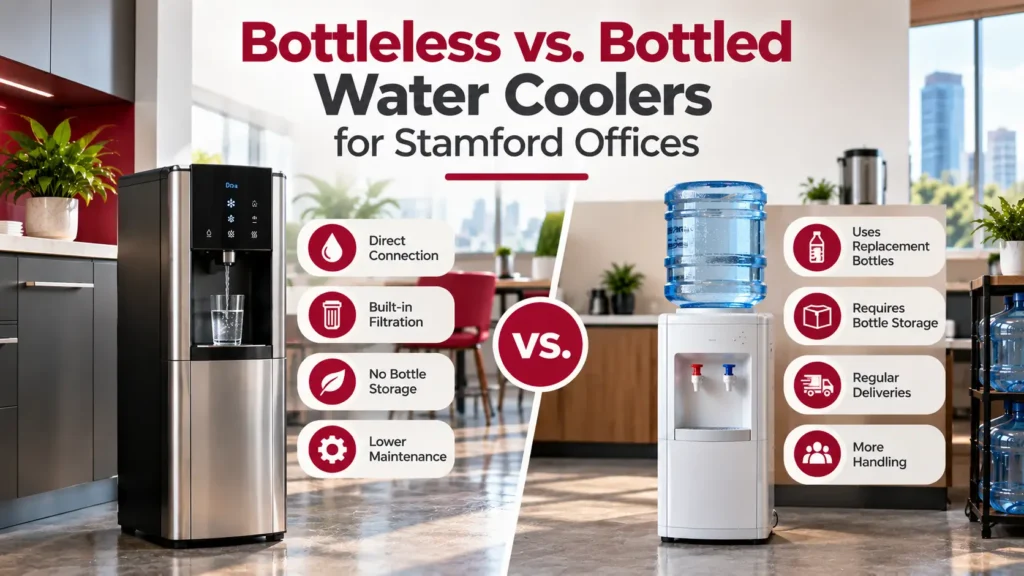
Providing convenient drinking water is an important part of creating a functional workplace break room. For Stamford offices, one of the biggest decisions is whether to use a traditional bottled water cooler or switch to a bottleless system. Both approaches can provide employees with convenient access to drinking water, but they work differently and come with different considerations for space, maintenance, installation, and everyday use.
A bottleless water cooler connects to a building’s existing water supply rather than relying on large replacement bottles. Depending on the equipment, the system may also include filtration and different temperature options. A bottled cooler, on the other hand, uses replaceable water containers that are delivered and exchanged as needed.
Neither option is automatically right for every Stamford workplace. The better choice depends on employee usage, available infrastructure, break room layout, maintenance preferences, and how the business wants to manage its workplace water service.
What Is a Bottleless Water Cooler?
A bottleless water cooler is a workplace drinking-water system that connects directly to a building’s water supply. Instead of placing a large bottle on top of or inside the equipment, water flows into the unit through a plumbing connection.
Many bottleless systems are designed to filter incoming water before dispensing it. The exact filtration method and capabilities depend on the equipment, so businesses should review the specifications of the system being considered.
A bottleless water dispenser can also offer practical advantages in workplaces where employees regularly refill reusable bottles. Because the water source is connected to the building, the business does not need to keep a supply of full replacement bottles stored nearby.
For offices with limited storage space, this difference can be particularly relevant. Instead of dedicating an area to water-bottle inventory, businesses can use that space for essential break room supplies or other employee amenities.
What Is a Bottled Water Cooler?
A bottled water cooler uses replaceable water containers as its source. The bottle is positioned on or inside the cooler, and employees dispense water directly from the equipment.
This format has been used in offices for many years and can be familiar to employees. Businesses do not necessarily need a dedicated plumbing connection at the cooler’s location, which can make bottled systems practical in some buildings.
However, bottled systems require an ongoing supply of replacement containers. Businesses need somewhere to store additional bottles, and someone needs to manage deliveries, replacements, and empty containers.
The amount of water used by the workplace is therefore an important consideration. A small office may have relatively modest demand, while a larger workplace can go through bottles much more quickly.
Bottleless Water Cooler vs. Bottled: What Is the Difference?
The biggest difference between the two systems is the way they receive water. A bottleless unit uses a direct connection to the building’s water supply. A bottled cooler depends on delivered water containers.
That difference affects several parts of workplace management.
| Consideration | Bottleless System | Bottled Cooler |
|---|---|---|
| Water source | Building water connection | Replacement water bottles |
| Storage | Little or no bottle inventory | Requires bottle storage |
| Installation | Requires suitable plumbing connection | Usually less dependent on plumbing |
| Filtration | May include filtration | Depends on water source and equipment |
| Replenishment | Connected water supply | Bottles must be replaced |
| Physical handling | Less bottle handling | Requires moving and changing bottles |
| Best fit | Offices seeking a plumbed solution | Locations where bottled delivery is practical |
The right decision should be based on the workplace rather than simply choosing the newer or more familiar format.
What Should Stamford Offices Consider Before Choosing?
Before selecting a water cooler, businesses should evaluate several practical factors. The most important question is not simply which equipment looks better. It is whether the system fits the building and the employees who will use it.
Employee Count and Daily Usage
Start by estimating how many employees will use the water station and comparing office water dispenser options suitable for that level of demand. A workplace with a small team may have very different requirements from a large Stamford office with several departments.
Consider when employees use the break room as well. If most employees take breaks around the same time, demand can be concentrated into relatively short periods.
Businesses should also consider whether employees regularly refill reusable bottles. If many employees use refillable bottles throughout the day, a dispenser may experience considerably more traffic than a workplace where employees primarily drink from individual cups.
Available Space
Space is another important consideration. A bottled system requires room not only for the cooler but also for replacement bottles. Those bottles can be heavy and may need to be stored close enough to the cooler for practical replacement.
A bottleless setup can eliminate the need for that bottle inventory, but the equipment still requires an appropriate installation area.
Before selecting a system, look at:
- Available floor and counter space
- Employee traffic patterns
- Nearby electrical access
- Existing plumbing
- Wall and cabinet locations
- Clearance around the equipment
- Distance from other break room appliances
The dispenser should be convenient without creating congestion.
When Does a Plumbed Water Cooler Make Sense?
A plumbed water cooler can be worth considering when a workplace has suitable access to its building water supply and wants to reduce dependence on delivered water bottles. Direct connection can be particularly useful for workplaces where employees use the water station frequently. Instead of scheduling replacement bottles, the system draws water through its connection to the building.
However, installation requirements need to be reviewed before assuming that a plumbed system will work in a particular location. The business should determine whether the proposed location has the necessary water connection and whether any installation work is required. Equipment placement should also take into account access for future service or maintenance.
For an office that already has suitable infrastructure near its break room, a plumbed system may be a practical option. For a location without convenient plumbing access, bottled water may remain easier to implement.
The Role of Filtration in a Bottleless System
Filtration is one of the features businesses may consider when evaluating a bottleless water system. A filtration component can be incorporated into some direct-connect systems to treat incoming water before it reaches the dispensing point.
The specific capabilities vary between systems, so businesses should not assume that every filter provides the same treatment.
When evaluating filtration, ask:
What Does the Filter Do?
Understand what the specific filtration system is designed to address. Different technologies have different purposes and capabilities.
How Often Does It Need to Be Replaced?
Filters are not permanent components. Businesses should understand the expected replacement schedule and how replacement is handled.
Who Handles Filter Service?
A workplace water solution should be easy for employees and facility managers to maintain. Ask whether filter changes and other routine maintenance are handled as part of the service arrangement.
Does Filtration Affect Installation?
The filtration setup may influence equipment placement and installation requirements. These details should be discussed before selecting the final location.
Bottleless Water Dispenser Benefits for Busy Offices
For some Stamford businesses, the biggest attraction of a bottleless system is convenience. Because the system is connected to the building’s water supply, employees can use the dispenser without waiting for a replacement bottle to be delivered or installed. The business also does not need to maintain a large inventory of full water bottles.
This can simplify the physical management of the break room.
Other potential advantages include:
- Less bottle storage
- Reduced handling of heavy replacement bottles
- Convenient access for frequent users
- Potential integration with filtration
- A consistent location for bottle refills
- More flexibility when break room storage is limited
These benefits are most relevant when they match the way a workplace actually operates. A business with very low water usage may not experience the same advantages as a larger office with frequent dispenser use.
What Are the Advantages of Bottled Water Coolers?
Bottled systems remain useful in many workplaces because they can be relatively straightforward where plumbing access is limited. A business does not necessarily need to install a dedicated water connection at the cooler’s location. Instead, water can be delivered in containers and placed on or inside the equipment.
This can be useful for offices where:
- Plumbing access is difficult
- The break room location may change
- The business prefers delivered water
- Existing infrastructure does not support a direct connection
- Water consumption is relatively predictable
The tradeoff is that bottled systems require ongoing physical management. Full bottles need to be delivered and stored, and empty bottles need to be removed or returned.
For some businesses, that arrangement is perfectly manageable. For others, the storage and handling requirements may become inconvenient over time.
How Much Space Does Each System Require?
Space requirements should be considered before choosing equipment, particularly in smaller offices. A bottled cooler takes up space at the dispensing location and may require additional storage for replacement bottles. The storage area needs to be accessible while remaining out of the way of employees.
A bottleless unit can reduce the need for water-bottle storage, but it needs a suitable installation location. If it requires a direct water connection, the business may have fewer options for moving the equipment later. This means the physical layout can influence the decision.
For example, an office with a compact kitchenette and limited storage may benefit from avoiding a stack of replacement bottles. A workplace without convenient plumbing near the employee area may find bottled service easier.
The best choice is therefore the one that fits both the equipment requirements and the room itself.
Maintenance Considerations for Stamford Offices
Every workplace water system requires some level of maintenance. The specific requirements depend on the equipment.
For a bottleless system, businesses should understand requirements related to filtration, cleaning, sanitization, and equipment service. If the unit includes filters, those components need to be replaced according to the manufacturer’s or service provider’s recommendations.
Bottled coolers also require cleaning and routine maintenance. In addition, the workplace needs to manage bottle replacement and storage.
When comparing the two, ask the provider:
- What routine maintenance is required?
- Who performs the maintenance?
- How are filter replacements handled?
- How are service issues reported?
- What parts or consumables need regular replacement?
- Is maintenance included in the service arrangement?
These questions help businesses understand the ongoing responsibility rather than focusing only on the initial equipment choice.
Which Option Is More Convenient for Employees?
From an employee perspective, convenience generally comes down to access. Employees should be able to reach the water station easily, refill bottles without difficulty, and use the dispenser without creating congestion. A bottleless system can make refilling convenient because employees do not need to wait for a new bottle to be placed on the cooler. A bottled cooler can also be convenient when it is positioned properly and replacement bottles are consistently available.
The surrounding environment matters just as much as the equipment. A dispenser located in an inconvenient corner may be underused regardless of the system type. Likewise, a high-quality system will not solve the problem if employees cannot comfortably access it during busy break periods.
How Water Service Fits Into a Complete Office Break Room
Water is usually only one part of the workplace refreshment experience. Employees may also expect coffee, snacks, meals, or cold beverages to be available in the same general area.
That means businesses should think about water service as part of the larger break room rather than making the decision in isolation. A water dispenser should complement the coffee station, refrigerator, vending equipment, pantry storage, or an office ice machine where additional ice access is part of the break room plan.
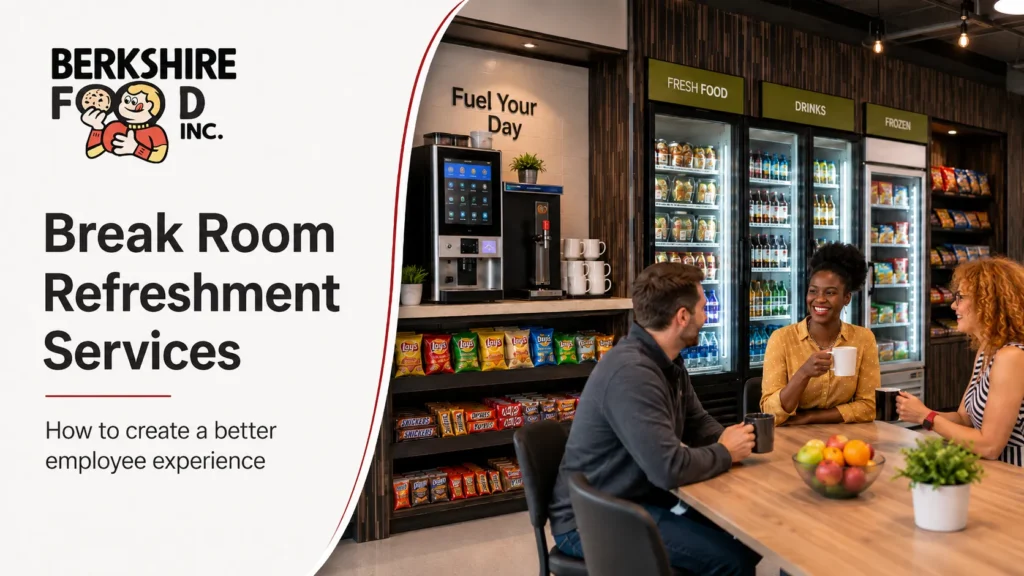
Businesses reviewing their broader approach to employee food and beverage access can also explore break room refreshment services to understand how different workplace refreshment options can work together.
The goal is to create a break room that is convenient without becoming overcrowded or difficult to manage.
Bottleless vs. Bottled Water: Which Is Better for Your Workplace?
There is no universal winner between the two systems.
A bottleless water cooler may be a better fit for a workplace that:
- Has suitable plumbing access
- Uses a significant amount of drinking water
- Wants to minimize bottle storage
- Has employees who frequently refill reusable bottles
- Is interested in a direct-connect filtration option
A bottled system may be more practical for a workplace that:
- Does not have convenient plumbing access
- Has relatively modest water consumption
- Already has a reliable bottle delivery arrangement
- Has enough storage for replacement bottles
- Wants flexibility in equipment placement
The important point is that bottleless water cooler vs. bottled should be evaluated as a workplace operations decision, not simply an equipment comparison.
Questions to Ask a Water Service Provider
Once a business has narrowed down its preferred system, speaking with a provider can help clarify the practical details. Ask about installation first. If you are considering a bottleless system, determine whether the proposed location is suitable for a direct connection and whether installation is included.
Next, ask about ongoing service. Understand who handles maintenance, filter changes, cleaning, and repairs.
Product specifications also matter. Find out which water temperatures are available, whether filtration is included, and how the equipment is designed for workplace usage.
Finally, discuss your employee count and expected usage. A provider can make a more appropriate recommendation when it understands how many people will use the system and how frequently they are likely to access it.
A Practical Decision Process for Stamford Offices
Businesses do not need to make the decision complicated. A simple evaluation process can help narrow down the options.
Step 1: Estimate Usage
Determine how many employees are likely to use the water station and whether demand changes throughout the day.
Step 2: Review the Break Room
Measure available space and look at existing equipment, traffic flow, outlets, and storage.
Step 3: Check Infrastructure
Determine whether a direct water connection is available or practical at the desired location.
Step 4: Decide Whether Filtration Matters
If filtered water is an important requirement, compare the filtration options available with the equipment being considered.
Step 5: Compare Ongoing Responsibilities
Look at bottle delivery and storage versus filter replacement, cleaning, and equipment maintenance.
Step 6: Consider the Complete Refreshment Program
Think about how water will work alongside coffee, snacks, meals, vending, or pantry services.
Step 7: Discuss the Setup With a Provider
Share your workplace size, layout, employee usage, and goals so the available options can be evaluated around your actual needs.
Choosing a Water Solution for a Stamford Workplace
Stamford offices can have very different workplace environments, from compact professional offices to larger facilities with multiple teams and schedules. That makes a one-size-fits-all approach less useful.
Businesses looking at refreshment solutions for their local workplace can review workplace refreshment services in Stamford, CT as part of the planning process.
If your office has suitable plumbing and frequent water usage, a bottleless system may be worth exploring. If plumbing access is limited or a delivered-water model fits your operations better, a bottled cooler may make more sense.
The decision should ultimately balance employee convenience, building requirements, space, maintenance, and ongoing service needs.
Frequently Asked Questions
Not necessarily. A bottleless system can reduce bottle storage and may provide filtered water through a direct connection, while a bottled cooler can be practical where plumbing access is limited. The better option depends on the workplace's infrastructure, usage, available space, and service preferences.
A bottleless water dispenser connects directly to a building's water supply. Water enters the equipment through the connection and may pass through a filtration system before being dispensed. The exact setup, filtration capabilities, and installation requirements depend on the specific equipment.
A plumbed water cooler is connected directly to a building's water supply instead of relying on replaceable water bottles. This type of system can reduce the need for bottle storage and handling, but the selected location must have suitable plumbing access and meet the equipment's installation requirements.
Yes, a bottleless system generally requires a connection to the building's water supply. Businesses should verify that the intended installation area has appropriate plumbing access before selecting this type of equipment.
Some bottleless water coolers include filtration systems, but the filtration technology and capabilities vary by equipment. Businesses should ask what the filter is designed to address, how frequently it needs replacement, and who handles filter maintenance.
Maintenance depends on the equipment and service arrangement. Bottleless systems may reduce bottle handling but can require filter replacement and routine equipment service. Bottled systems require regular bottle replacement in addition to routine cooler maintenance.
They can, because businesses generally need space for replacement water bottles in addition to the cooler itself. The amount of storage required depends on employee usage and how frequently replacement bottles are delivered.
Start by reviewing employee usage, available space, plumbing access, filtration preferences, and maintenance requirements. Then compare the ongoing responsibilities and service arrangements for each option. A provider can help evaluate the available choices based on the workplace's specific requirements.