
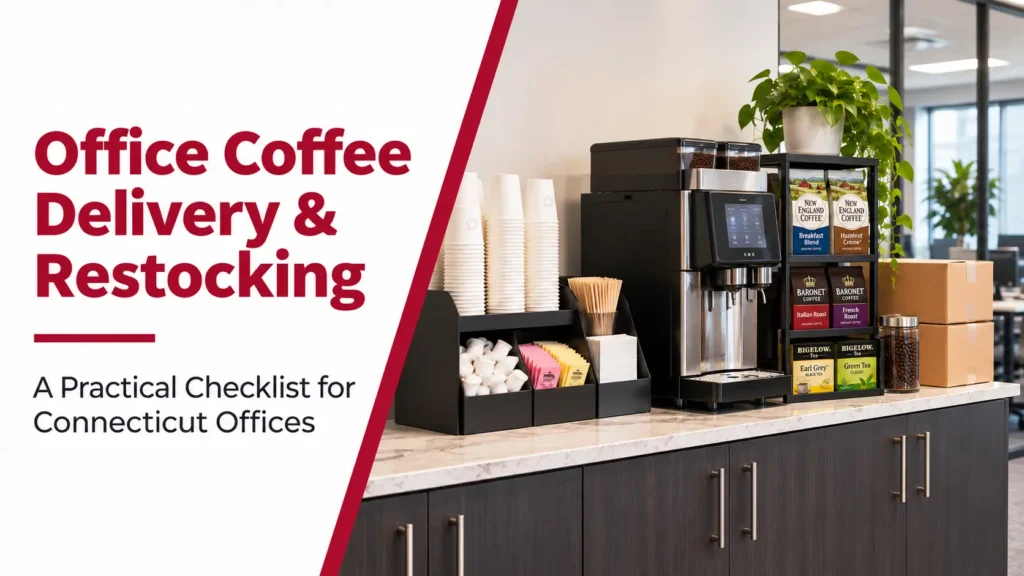
Running out of coffee is an obvious problem, but it is rarely the only supply issue in a workplace break room. A coffee machine may be ready to brew while employees discover that cups, creamers, filters, or their preferred beverages are missing. These small shortages can become recurring frustrations when no one has a clear system for checking inventory and arranging replenishment.
For Connecticut businesses, managing office coffee supplies requires more than placing an occasional order. Employee attendance, coffee consumption, brewing equipment, storage space, and delivery arrangements all influence how much stock a workplace needs. A small professional office in Stamford may use supplies differently from a busy healthcare facility in New Haven or a manufacturing workplace in Waterbury.
An organized coffee delivery and restocking process can help businesses maintain product availability without filling cabinets with unnecessary inventory. This guide explains how to estimate coffee demand, choose essential supplies, establish reorder points, and create a practical replenishment checklist for Connecticut workplaces.
Why Office Coffee Supply Management Matters
A coffee station is only convenient when employees can prepare the beverages they want without searching for missing products. Even a well-maintained commercial brewer becomes less useful when the supplies needed to operate it are unavailable.
Office coffee inventory can be difficult to manage because different products are consumed at different rates. Coffee may last several weeks, while cups disappear quickly during meetings. Creamers and sweeteners may need different quantities, and hybrid attendance can create unpredictable periods of higher consumption.
Without an established process, supply management often becomes an informal responsibility shared between office managers, administrative staff, and whoever notices a shortage first. Orders may be placed too late, popular products may run out, or extra inventory may accumulate because purchasing decisions are based on guesses.
A practical restocking system helps businesses understand what employees use, when replenishment is needed, and who is responsible for coordinating the next order.
What Office Coffee Supplies Should Every Workplace Stock?
A complete workplace coffee station needs more than coffee products. The exact assortment depends on employee preferences, brewing equipment, and whether the business provides beverages as a complimentary workplace amenity.
Most offices can organize their supplies into a few practical categories.
| Supply Category | Common Items | Restocking Consideration |
| Coffee Products | Ground coffee, whole beans, single-serve products, decaf | Track servings and preferred varieties |
| Tea & Other Beverages | Tea bags, hot chocolate, compatible drink products | Review individual product demand |
| Serving Supplies | Cups, lids, stirrers, napkins | Account for meetings and visitors |
| Creamers & Sweeteners | Creamer, sugar, alternative sweeteners | Consider consumption and storage requirements |
| Brewing Essentials | Filters and compatible machine consumables | Match supplies to equipment specifications |
| Station Accessories | Organizers, storage containers, dispensing accessories | Replace or maintain as needed |
| Equipment Care | Approved cleaning products and maintenance consumables | Follow manufacturer instructions |
Coffee Products and Beverage Choices
Coffee products are the foundation of the station, but the right quantity depends on the brewing system. Traditional batch brewers, single-cup machines, and bean-to-cup equipment can use different product formats, making direct comparisons between package quantities difficult.
An office should begin with the beverages employees regularly choose. If medium roast coffee is consistently popular, it may need a larger share of inventory than a specialty flavor used occasionally.
Decaffeinated coffee and tea can also provide useful alternatives. The goal is to maintain a selection that employees enjoy without carrying excessive quantities of products that receive little interest.
Cups, Creamers, and Everyday Essentials
Serving supplies are easy to overlook because they may be stored separately from the coffee itself. However, a shortage of cups, lids, or creamers can affect employees even when enough coffee remains available.
Businesses should monitor these items independently rather than assume they will be consumed at the same rate as coffee. An office using reusable mugs may require fewer disposable cups, while a workplace that regularly hosts visitors may need more serving supplies than its employee count suggests.
When evaluating coffee supplies for office use, consider how products are stored, how quickly they are consumed, and whether employees can access them conveniently.
How Much Coffee Does Your Office Actually Need?
The most useful starting point for inventory planning is average daily consumption, not total employee headcount. Some employees drink several cups during the workday, while others rarely use the coffee station.
Hybrid attendance, meetings, multiple shifts, and different beverage preferences can all affect demand. A workplace with 70 employees on its payroll may have fewer daily coffee users than a smaller facility where nearly everyone works onsite.
Estimate Weekly Coffee Consumption
A simple planning calculation can help establish an initial supply target:
Average daily coffee drinkers × average cups per person × workdays = estimated weekly servings
Consider a Connecticut office with 40 regular onsite employees. If each employee drinks an average of 1.25 cups of workplace coffee per day over a five-day workweek, the estimated demand would be:
40 employees × 1.25 cups × 5 days = 250 coffee servings per week
This is an illustration rather than a standard consumption rate. Actual usage should be measured whenever possible.
The business can then translate those servings into the product quantities required by its specific machine. Single-serve products can be counted individually, while ground coffee or whole beans must be calculated according to the selected brewer’s recommended portions.
Account for Meetings, Visitors, and Shift Changes
Normal daily demand does not always represent the busiest periods. A company hosting frequent meetings may use additional coffee and cups on particular days. Similarly, an industrial workplace may experience concentrated demand during shift changes.
Office managers should identify these patterns before establishing a long-term ordering schedule. If consumption changes significantly during certain weeks, a flexible replenishment arrangement may be more practical than ordering the same quantity every time.
How to Manage Office Coffee Supplies Without Running Out
The most effective way to manage office coffee supplies is to track consumption, establish minimum inventory levels, and reorder before stock reaches a critical point. The process should also identify who checks supplies and how delivery requests are submitted.
A workplace does not need a complicated inventory system to accomplish this. A simple spreadsheet, shared checklist, or inventory record can provide enough information to identify frequently used products and recurring shortages.
Track Inventory by Product
Start by recording the quantity of each essential product currently available. Keep high-use items such as coffee, cups, creamers, and sweeteners separate so shortages are easier to identify.
Over several weeks, compare the amount used with employee attendance and any unusual events. This will help the business identify which supplies need frequent replenishment and which can be ordered less often.
Establish Minimum Stock Levels
A minimum inventory level is the quantity that signals a new order should be placed. It should account for how quickly products are consumed and how much time may pass before replenishment arrives.
For example, suppose an office uses an average of 50 coffee servings per workday. If replenishment normally requires three business days and the workplace wants a two-day reserve, its planning threshold could be:
50 daily servings × (3 delivery lead-time days + 2 reserve days) = 250 servings
In this illustration, the office would arrange replenishment when available stock approaches 250 servings.
The reserve is a planning assumption, not a universal requirement. Businesses should adjust it based on actual service arrangements, product availability, storage space, and how consistently their consumption can be predicted.
Assign Clear Ordering Responsibilities
Inventory management works better when a designated workplace contact knows which items to review and how replenishment is requested.
Employees should also have a simple way to report low supplies. This prevents shortages from going unnoticed until the coffee station becomes unusable.
Where a managed coffee program is in place, clarify which stocking and ordering tasks are handled by the service provider and which remain the responsibility of the business.
How Often Should Office Coffee Supplies Be Restocked?
There is no single restocking schedule that works for every office. The appropriate frequency depends on daily consumption, product storage, available inventory, and the delivery arrangement.
A smaller professional office may have enough storage to order supplies less frequently. A high-traffic corporate facility or multi-shift workplace may need more regular replenishment because employees consume products more quickly.
Match Delivery Frequency to Consumption
When comparing a coffee delivery service for offices, ask how the provider determines appropriate delivery quantities and schedules.
Some programs may use recurring deliveries, while others may rely on customer orders or arrangements based on observed demand. The business should understand the available process before committing to a schedule.
The objective is to replenish products before shortages occur without keeping more stock than the workplace can reasonably use or store.
Review the Schedule as Demand Changes
A delivery schedule that worked when an office had 25 employees may become unsuitable after the company expands to 60. Changes in hybrid attendance, operating hours, or employee preferences can also affect supply requirements.
Review coffee consumption periodically and discuss adjustments when certain products repeatedly run out or remain unused.
An effective delivery plan should follow the workplace’s actual needs rather than remain unchanged simply because it was established during the initial setup.
Practical Office Coffee Restocking Checklist
A consistent checklist helps office managers identify supply needs before they become problems. It can also provide a useful starting point for discussing delivery and stocking responsibilities with a coffee service provider.
Use this checklist during regular inventory reviews:
- Check Coffee Inventory: Count remaining coffee products and confirm that popular varieties are available.
- Review Tea and Decaf: Check alternative beverage choices according to actual demand.
- Inspect Serving Supplies: Review cups, lids, napkins, stirrers, and other essentials.
- Check Creamers and Sweeteners: Confirm quantities, packaging condition, and applicable storage requirements.
- Review Brewing Essentials: Identify compatible filters and other consumables that may need replenishment.
- Check Product Dates: Rotate suitable products and identify stock approaching its recommended use date.
- Confirm Equipment Condition: Note cleaning needs, warning messages, or service concerns according to the manufacturer’s instructions.
- Prepare the Next Order: Compare current stock with reorder points and communicate supply needs through the established ordering process.
The checklist can be adapted to match the equipment and beverage choices used by the workplace.
A station with a traditional batch brewer will have different inventory needs from one using individual coffee products. Businesses should avoid adding unnecessary items simply to make the checklist more extensive.
Office Coffee Delivery Service vs. One-Off Supply Shopping
Some offices manage coffee by purchasing products from retail stores or placing individual orders whenever supplies run low. This approach can be manageable for small teams with predictable demand and staff available to coordinate purchasing.
However, the process becomes more demanding when coffee consumption increases. Someone must monitor stock, prepare orders, receive products, store inventory, and arrange solutions when something is unavailable.
A managed office coffee delivery service can help coordinate some of those responsibilities under an agreed arrangement.
| Consideration | One-Off Supply Shopping | Managed Coffee Delivery |
| Purchasing | Internal staff place separate orders | Ordering follows the agreed program |
| Inventory Planning | Managed by workplace personnel | May include provider guidance or support |
| Product Selection | Depends on purchasing sources | Based on available program products |
| Delivery | Arranged for individual purchases | Coordinated under service terms |
| Equipment Support | Arranged separately | May be included in the coffee program |
| Ongoing Administration | Primarily handled internally | Responsibilities can be shared with the provider |
Neither approach is automatically better for every business. The decision should reflect staff time, product demand, equipment requirements, and the service options available.
For workplaces evaluating a managed solution, Berkshire Food’s office coffee service brings together commercial brewing equipment, beverage selections, supplies, delivery, and ongoing support based on the program.
How Connecticut Workplaces Can Adjust Their Restocking Plans
Different workplaces need different inventory and delivery arrangements. Employee count matters, but attendance patterns and operating schedules can have just as much influence on consumption.
Corporate and Professional Offices
Professional offices in communities such as Stamford, Greenwich, and Fairfield may experience changing attendance throughout the week. Meetings and visitors can also increase demand for coffee and disposable serving supplies.
These workplaces should review which days have the highest consumption and consider whether delivery quantities need to reflect those patterns.
A practical supply plan can help maintain employee coffee access without using excessive cabinet space for products that are rarely consumed.
Healthcare and Administrative Facilities
Healthcare offices and administrative facilities may have employees taking breaks at different times. Coffee access should reflect the number of staff using the station and whether beverage demand extends beyond a standard daytime schedule.
The replenishment process should also account for staff changes, peak usage periods, and the responsibilities assigned to maintaining shared beverage areas.
Manufacturing and Warehouse Workplaces
Industrial workplaces may have concentrated coffee demand at the beginning of a shift or during scheduled breaks. When several teams share one station, inventory can decline more quickly than expected.
Facilities operating multiple shifts should check whether enough supplies remain available for employees working later in the day.
Equipment capacity, product storage, and restocking arrangements should be evaluated together rather than treating coffee delivery as a separate purchasing decision.
Avoid These Common Coffee Restocking Mistakes
An office does not need to purchase large quantities of every product to keep its coffee station running smoothly. Better supply management comes from understanding actual demand and correcting recurring problems.
Ordering Based Only on Employee Headcount
Employee count provides a starting point, but it does not show how many people drink coffee or how many servings they consume.
A more accurate plan considers actual onsite attendance and consumption. Businesses should review purchasing records and employee feedback before increasing quantities.
Waiting Until Supplies Are Almost Empty
Ordering after the last package has been opened leaves little room for unexpected demand or delivery changes.
Minimum inventory levels can help businesses begin replenishment before an essential product runs out. High-use products should receive particular attention because their shortages affect the most employees.
Purchasing Too Many Unpopular Products
Offering beverage variety can be useful, but keeping large quantities of products that employees rarely choose may create unnecessary costs and storage problems.
Review consumption periodically and adjust quantities based on actual preferences. Maintaining dependable everyday favorites is often more practical than continually expanding the selection.
Overlooking Storage and Product Rotation
Coffee products and related supplies need suitable storage conditions. Businesses should follow packaging instructions, protect stock from unnecessary moisture or heat, and use appropriate rotation methods.
Creamers, milk, and other products with special storage requirements should be handled according to their labels. Supplies should remain accessible without overcrowding counters or equipment areas.
How Office Coffee Restocking Affects Your Budget
Supply management influences more than product availability. Ordering quantities, brewing formats, disposable products, and unused inventory can all affect how much a workplace spends on coffee.
Businesses should evaluate total program costs rather than focus only on the price of coffee itself. Cups, creamers, sweeteners, filters, equipment support, and any applicable delivery charges may need to be included in the budget.
Tracking consumption helps identify products that are regularly wasted or purchased in unnecessary quantities. It can also reveal whether the existing brewing equipment matches how employees actually use the station.
For a more detailed explanation of workplace coffee expenses, see our Office Coffee Service Cost in Connecticut guide.
The most useful budget is one based on realistic demand and the actual services included in the workplace’s arrangement.
Choosing the Right Coffee Delivery Partner in Connecticut
A coffee delivery provider should understand more than the number of employees at a workplace. The arrangement should account for the beverages employees prefer, the equipment being used, storage capacity, operating schedules, and the amount of support the business needs.
When reviewing a provider, ask how deliveries are arranged, which coffee and supply products are available, how quantities can be adjusted, and which equipment-support responsibilities are included.
The company should also be able to explain the conditions of the proposed service agreement. Clear expectations help businesses understand what they need to manage internally and what support will be provided.
For businesses planning their first managed coffee program, Berkshire Food’s Office Coffee Service Guide explains how brewing equipment, beverage selections, delivery arrangements, and ongoing support work together. Reviewing these fundamentals can help office managers choose a program that fits their workplace before establishing a long-term restocking routine.
How Berkshire Food Supports Workplace Coffee Programs
Berkshire Food is a family-owned and operated workplace refreshment provider serving Connecticut and Upper Westchester County, New York. Since 1964, the company has supported businesses with workplace refreshment solutions that include office coffee service, vending, water service, micro markets, and pantry programs.
Berkshire Food’s coffee service options bring together brewing equipment, coffee and tea products, serving supplies, delivery, stocking support, and ongoing service based on workplace requirements.
Businesses can discuss their employee count, current coffee consumption, equipment preferences, and replenishment needs to explore a suitable program.
The goal is to create a coffee station that employees can use conveniently while giving workplace managers a clearer approach to products, supplies, and ongoing responsibilities.
Keep Your Connecticut Office Coffee Station Ready
A dependable coffee station begins with understanding what employees consume and establishing a practical plan for keeping essential products available. By tracking coffee usage, reviewing supplies, setting reorder points, and coordinating delivery around actual workplace demand, businesses can reduce recurring shortages without accumulating unnecessary inventory.
Whether you manage a small professional office or a larger workplace with several shifts, a clear restocking process makes the coffee station easier to maintain and more convenient for employees.
Ready to improve your office coffee delivery and supply management? Contact Berkshire Food to discuss brewing equipment, coffee selections, replenishment needs, and available service options for your Connecticut workplace.
Frequently Asked Questions
Most workplace coffee stations need coffee products, cups, creamers, sweeteners, stirrers, napkins, and any filters or consumables required by the brewing equipment. Tea, decaf, and other beverages can also be included based on employee preferences. Exact quantities depend on attendance, consumption, and the workplace's chosen equipment.
Ordering frequency depends on consumption, storage space, product availability, and delivery arrangements. Businesses should track how quickly supplies are used and establish reorder points that account for expected delivery time and a suitable reserve. A consistent schedule may need adjustment as demand changes.
A coffee delivery service for offices may provide coffee products, compatible beverages, serving supplies, scheduled or requested deliveries, and stocking support. Some managed programs also include brewing equipment and maintenance arrangements. The exact services and charges should be confirmed with the provider.
A small business can monitor average weekly coffee consumption, identify its most-used products, and set minimum inventory levels. Reviewing supplies before they become critically low helps reduce last-minute purchases. A simple inventory checklist is often sufficient when coffee demand is modest.
Delivery quantities may be adjustable depending on the provider and service arrangement. Businesses should communicate staffing changes, new shifts, or changes in onsite attendance so the product selection and replenishment schedule can be reviewed.
It depends on the workplace. Independent purchasing may be manageable for a small team, while managed delivery can help coordinate ordering, products, equipment, and agreed support responsibilities. Businesses should compare total costs and the time employees spend managing coffee supplies before deciding.
Yes. Berkshire Food provides workplace coffee service and coffee delivery support across Connecticut and Upper Westchester County, NY. Available programs can include coffee equipment, beverage products, serving supplies, stocking assistance, and ongoing support based on individual workplace needs.